
More than 230 million people ask ChatGPT about health and wellness every week. Some of them follow you, and some have already bought your program. When they want to know how much weight to add or what to do after a missed day, a lot of them ask the AI, and it answers with general advice because it has never seen your program.
You can now sell your program as a skill, which is a file your buyer adds to ChatGPT, Claude or Gemini. Once it’s there, when they ask about their training, the answers come from your program.
Programmers started making skills about a year ago. The biggest directory of them now lists more than 1.4 million, the most popular one has been installed 4.4 million times, and people pay for them. Fitness creators are just getting started, and a lot more people ask AI about their health than write code for a living.
We think this is a good time to make one. You’ve already written the program, so most of the work is done, and if you start now you’ll be one of the first fitness creators selling a skill. The rest of this is why we think a skill is worth selling and how to make one from the program you already have.
What is an AI skill?
An AI skill is a file that tells an AI app how to do one job. A fitness creator’s skill holds their program, along with their answers to the questions buyers ask, like how to pick a starting weight or what to do after a missed day.
You sell a skill the way you’d sell a PDF. You set a price and put it in your store, and the buyer gets the files after they pay. They add it to their AI app once, which takes a few minutes, and after that it’s there whenever they ask.
If that sounds odd, creators have sold files made for someone else’s app for years. Photographers sell presets for Lightroom, and lots of people sell templates for Notion. A skill is the same kind of thing, made for an AI app.
A skill also gets used a lot more than a PDF does. Most people read a PDF program once at the start, and after that they only open it to check the day’s workout. A skill gets used every time they ask the AI something about the program.
Which AI apps can use a skill?
Over the last year, all three of the big AI apps have started taking skills.
Anthropic brought skills to Claude in October 2025, and in December it published how a skill is laid out so other companies could use the same format. On November 17, 2026, Google started turning Gems, Gemini’s custom assistants, into skills, and the old Gems are gone on December 17. OpenAI is retiring custom GPTs on December 11 and moving them into plugins. In ChatGPT, your buyer puts a skill in a project, which keeps instructions and files together for one topic.
So whichever of the three your followers use, they can add a skill to it today.
Are people already buying AI skills?
Yes. So far it’s mostly programmers, since that’s who skills caught on with first. The biggest directory of them, skills.sh, run by the software company Vercel, lists more than 1.4 million skills. Its most popular one has been installed 4.4 million times, and more than 20 others have passed a million.
People pay for them too. On Agensi, a store that sells skills, more than 4,000 people have listed skills they made, and the paid ones on its front page cost between $9 and $17. Most of them are someone’s way of doing their job, like designing a website or checking code for security problems, written down for an AI to follow. A fitness creator’s skill is the same idea, with your program and your answers written down.
Why sell your program as a skill?
It’s something new to sell, and you make it from a program you’ve already written. Some of your buyers will only ever want the PDF. Others will want your program in the AI app they open every day, and you can sell to both.
You’d be early, too. Programmers have had skills for about a year and have made more than a million of them. Fitness creators are just getting started, so if you put a skill in your store now, it’ll probably be the first one your followers have seen.
A skill puts your program where your buyers already take their questions. Right now, when they ask AI about their training, the answer doesn’t come from you. With a skill, the answer they get in week three is the one you’d give them.
A skill also keeps them on your program. Ask ChatGPT about a workout from your program and it will often suggest changes, like more sets or a different split, because it doesn’t know why you wrote it the way you did. With a skill, the AI goes by your program, so your buyer keeps doing what you wrote.
You’ll answer fewer DMs, too. When you make a skill, you write down what your buyers ask you, and you’ll find questions your program never answers, like how to pick a starting weight or what to do when the program ends. You answer them once, and your buyer gets your answer whenever they ask, even at 11 at night. If you sell the PDF too, you’ll probably want to put some of those answers in it as well.
What happens when someone buys a skill
Your buyer pays and gets the files. They add the skill to ChatGPT, Claude or Gemini on their own account, which takes a few minutes the first time.
Then they ask it something. A good first question is “I just got this. Where do I start?” A well-made skill asks a couple of things back before it answers, like which week they’re on and what equipment they have.
From then on, when they ask about the program, the AI answers from it. If they ask how many sets of squats are on Thursday, it knows. If they ask what to do after missing a day, and you wrote an answer to that when you made the skill, they get your answer. If you didn’t, a well-made skill says your program doesn’t cover it. It doesn’t make up a rule and put your name on it.
We also think a skill should never pretend to be you. It’s an AI following your program, and it should say so. Your buyer’s chats stay on their own account, so you never see them.
Can’t my buyers just upload my PDF to ChatGPT?
They can. ChatGPT, Claude and Gemini will all read a PDF and answer questions about it.
The problem comes when the answer isn’t in the PDF. Plenty of programs don’t say how long to rest between sets, or what to do when there’s no squat rack free. The AI will usually fill the gap with general advice, and your buyer often can’t tell which part came from you. A skill has your answers to those questions, and when your buyer asks something you didn’t answer, it tells them your program doesn’t cover it.
A PDF also doesn’t tell the AI how to help. A skill can tell it to check where your buyer is in the program before it answers, and to stay away from anything you said it should never do, such as recommending supplements.
And a PDF uploaded to a chat stays in that chat. In a new chat next week, your buyer has to upload it again. A skill is added once and stays in their account.
Is AI making workout PDFs harder to sell?
You’ve probably seen people say it is. Anyone can get a 12-week program from ChatGPT for free, so why would they pay $30 for yours? A company that sells software to coaches wrote this year that a coach’s 2025 offer is “already obsolete”.
Other people say followers buy a program because of who made it. They’ve watched you train for months, and they want your program in particular. When Les Mills, which makes group workout classes, surveyed more than 10,000 people for its 2026 fitness report, only 10% said they’d rather have a workout led by AI than by a person.
Both sides assume your buyer picks either ChatGPT or your program. With a skill, they don’t have to pick. They ask ChatGPT, and it answers from your program.
What a skill can’t do
Your buyer has to add the skill to their AI app themselves. It takes a few minutes and it’s a step a PDF doesn’t have, so some people will need a hand the first time.
Each AI app words its answers a little differently, even with the same skill. If you make one, add it to the app your followers use most and ask it what they’d ask you.
A skill only knows what’s in it. It can’t watch someone squat or tell whether a weight was too heavy for them. It answers what your buyer types, from your program and your answers.
A skill is still an AI, and it can get an answer wrong. That’s why it’s worth asking it a lot of questions before you sell it, and fixing what it gets wrong.
A skill is a file, so a buyer can send it to a friend, the same way they can forward a PDF.
How to make a skill from your program
Start from the program you already sell. A skill holds one plan, so if you sell three programs, that’s three skills.
Then write down what your buyers ask you. Go through your DMs and comments from people who bought the program, and look for the questions that come up again and again. Answer each one the way you’d text a client, in a sentence or two. These answers are most of what makes a skill yours, since the AI already knows general training advice.
Write down anything the skill should never do, like recommend supplements or give advice about an injury.
Before you sell the skill, try it out. Ask what a buyer would ask in their first week and again in their last, and read every answer as if a client had sent it to you. If one is wrong, fix the answer in the skill and ask again.
You can build the file by hand if you’re comfortable with that. A skill is a folder of text files with a main one called SKILL.md, and Anthropic publishes how it should be laid out. Most of the work is the writing above, whichever way you build it.
Where trainlike.link comes in
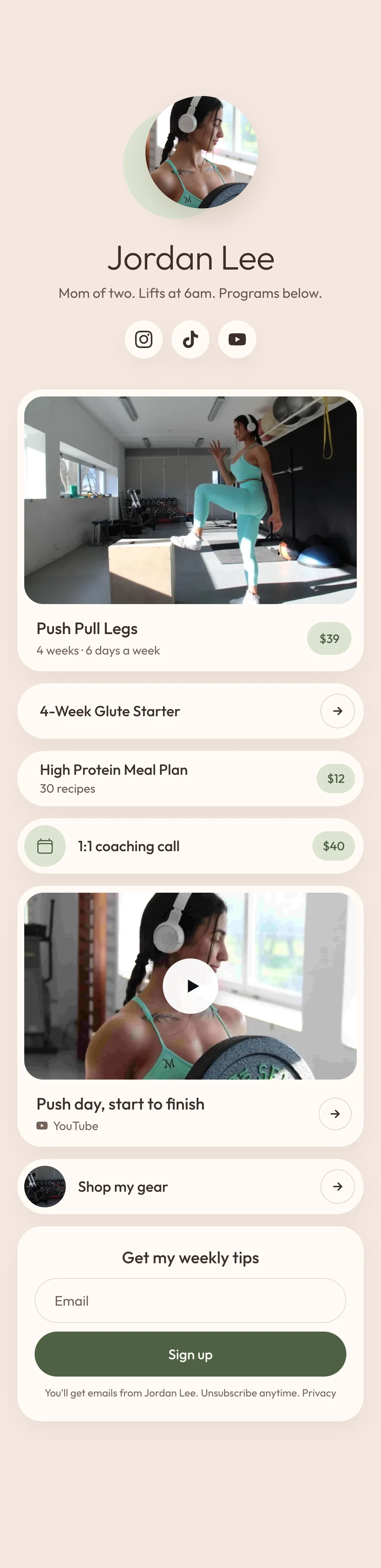
We make trainlike.link, so take this part as the pitch. It’s a store for fitness creators that goes in your bio, and on Plus, our monthly plan, you can turn a program into a skill there.
You upload your program as a PDF, Word or Excel file, or pick a program you built in the store. We copy your program out so you can check every number. Your program won’t cover everything a buyer asks, so we show you those questions, and you answer each one or skip it. If you skip one, the AI tells your buyer that your program doesn’t cover it. Then you put it on your page with a price, like anything else you sell. Your buyers get the files right after they pay and by email, with a short guide to adding them to ChatGPT, Claude or Gemini.
Questions people ask
What is an AI skill?
A file you add to an AI app like ChatGPT, Claude or Gemini that tells it how to do one job. A fitness creator's skill holds their program and their answers to the questions buyers ask, so the AI goes by the program when the buyer asks about their training.
Do skills work in ChatGPT?
Yes. Claude and Gemini call them skills. In ChatGPT, your buyer puts the skill in a project, which keeps instructions and files together for one topic.
Does a skill pretend to be me?
No. It follows your program and your answers, and it says it's an AI. It never says it's you.
What happens when a buyer asks something my program doesn't cover?
If you wrote an answer to that question when you made the skill, the AI gives your answer. If you didn't, a well-made skill says your program doesn't cover it, instead of making up a rule and putting your name on it.
Can't my buyers just upload my PDF to ChatGPT?
They can, and the AI will answer questions about it. But when the answer isn't in your PDF, it fills the gap with general advice. A skill has your answers to those questions, and tells your buyer when your program doesn't cover something.
Can I make a skill from a PDF I already sell?
Yes. Most of what goes in a skill is already in your PDF. What you add is your answers to the questions the PDF doesn't cover, like what to do after a missed day.
Can a skill be a meal plan?
Yes. A skill holds one plan, so it can be a training program, a meal plan or a guide.
Should I stop selling my PDF?
No. Keep selling your PDF, and put the skill next to it in your store.
Where our facts came from
Read in November 2026.
- The 230 million number is OpenAI’s, from its launch of ChatGPT Health in January 2026, as reported by Fortune.
- Les Mills, We want humans, not algorithms, on its 2026 Global Fitness Report.
- Google’s help page, About the transition from Gems to skills.
- TechRepublic on custom GPTs retiring, for the December 11 date.
- Anthropic’s help page on skills in Claude, and the skill format at agentskills.io.
- The “already obsolete” line is the headline of a 2026 blog post by a company that sells community software to coaches.
- skills.sh, for the number of skills and the installs, read on November 18, 2026.
- Agensi, for the number of people selling skills and the prices on its front page, read on November 18, 2026.