
We went looking for what a workout program should cost, and most of what we found was no help. One page says a six-week program is worth somewhere between $50 and $500. Another says twelve weeks runs from $100 to $1,000. Neither says where those numbers came from, and a range that wide doesn’t tell you what to type into the price box.
So we looked at what creators are charging right now. We opened the stores of eight coaches who sell programs from their link in bio, plus the shops of a few people with millions of followers, and wrote down every price.
How much should you charge for a workout program?
For a program people follow on their own, somewhere between $25 and $50. If you can’t decide, make it $29 and look again after your first ten sales.
That’s lower than a lot of the advice out there. But one of the best-known lifting channels on YouTube, with millions of subscribers, sells most of its programs for $39.99, and a follower who’s wondering whether to pay you $90 can find that out in about ten seconds.
The rest of this is how we got to that range, what you keep from each sale, and when it makes sense to go above it.
What creators charge right now
In November 2026 we read the store pages of eight coaches who sell a program from the link in their bio. We found them by searching for programs, so this isn’t a proper survey, and eight is a small number. It’s still more than the pricing advice we read had to show for itself.
| The program | Price |
|---|---|
| 6 weeks in the gym, 4 days a week, with a sample meal plan | $24.99 |
| 12 weeks in the gym, 5 days a week | $26.99 |
| 4 weeks, 3 days a week, with a short nutrition guide | $27 |
| 4 weeks with dumbbells, 4 days a week | $34 |
| 4 weeks at home for beginners | $34 |
| 12 weeks of follow-along videos, 5 days a week | $49.99 |
| 6 weeks in the gym, with two nutrition guides | $67 |
| 4 weeks at home, with a video for every exercise | $111 |
Six of the eight are between $24.99 and $49.99. We’ve left the names out, because prices change and none of this is a review of anybody’s program.
A longer program doesn’t cost more
Look at the table again. The 12-week gym program is $26.99, and the most expensive one on the list runs for 4 weeks.
Most pricing advice goes by length, so much for four weeks, more for six, a lot more for twelve. We couldn’t find that in what people really charge. It makes sense when you think about the buyer, who isn’t counting weeks. They want to know if the program is for someone like them and whether it’ll get them what they’re after.
So don’t add weeks to a program so you can charge more for it. A program someone finishes is worth more to them, and to you, than a longer one they drop in week five.
Bigger creators don’t charge much more
We expected the famous names to be expensive, and they aren’t.
The YouTube channel we mentioned sells full programs for $39.99 and a smaller one, for arms only, at $19.99. Another creator with a big following sells her 12-week guides for a little over £40. A third has more than three million subscribers, puts every workout on YouTube for free, and sells the month’s calendar for $8.99.
They can afford to, because they sell thousands of copies. You won’t sell thousands, at least not yet, and it’s tempting to make up for that with a higher price. The trouble is that your followers watch these people too. They’ve seen what a program costs from someone much better known than you, and that’s the number in their head when they land on your page.
What lets you charge more
Two programs on our list cost more than $50. The $67 one comes with two nutrition guides and a video for every exercise. The $111 one has videos and nutrition advice as well, and from the page alone we can’t tell you why it’s priced so far above the rest. It may be that her followers trust her enough to pay it, which is a fine reason.
From what we’ve seen, a few things let a creator go higher. One is extras a buyer would otherwise pay for, like a meal guide. Another is being able to reach you, even if that’s only a group chat where you answer questions once a week. Proof helps a lot. A page with ten messages from people who ran the program can ask for more than a page with none.
Who the program is for matters as well. There are thousands of push pull legs programs, and yours has to compete with all of them on price. A program for runners who want to keep lifting through marathon training has far fewer rivals, and the person it’s written for will pay more to get something that fits.
What you keep from each sale
The price on the page isn’t what lands in your bank. The store may take a cut, and the card company always does. This table uses a store that takes 9% and Stripe’s US card fee, which is 2.9% plus 30 cents.
| Price | Store’s cut | Card fee | You keep | Sales to make $1,000 |
|---|---|---|---|---|
| $10 | $0.90 | $0.59 | $8.51 | 118 |
| $19 | $1.71 | $0.85 | $16.44 | 61 |
| $29 | $2.61 | $1.14 | $25.25 | 40 |
| $39 | $3.51 | $1.43 | $34.06 | 30 |
| $49 | $4.41 | $1.72 | $42.87 | 24 |
The 30 cents is charged on every sale whatever the price, so it hurts most on a cheap program. At $10 you lose 15% of the sale to fees, and at $49 you lose about 12.5%.
The last column is the one we’d look at. Getting 24 people to buy is a very different job from getting 118.
Is a low price the safe choice?
It feels safe. If the program is $12, surely more people will buy it.
Some more will. But at $19 you need about twice as many buyers as at $39 to make the same money, and we doubt that halving a price doubles your sales. We’d love to show you a number for that. We looked, and nobody has published how the price of a workout program changes how many people buy it. The figures you’ll see quoted come from companies that sell store software, and they don’t show their working.
There’s some research on what a low price does to how people judge a thing. In a 2005 study, people who bought an energy drink at a discount went on to solve fewer puzzles than people who paid full price for the same drink. That was a lab and a drink, so we wouldn’t lean on it much. It does match something most of us have felt, which is that a $7 program looks like it can’t have much in it.
Our view is that the fees and the sums both point the same way, and a first program shouldn’t go below $19.
Should it be $29 or $30?
Make it $29.
A researcher at the University of Chicago went through the prices and sales of 1,710 products across 248 stores of a US supermarket chain. Shoppers treated the one cent between $4.99 and $5.00 as if it were 15 to 25 cents. Sales dropped more than a cent should explain whenever the first digit of the price went up.
That was groceries, and nobody has run the same study on workout programs. But ending your price in a 9 costs you a dollar at most, so we’d do it.
Crossed-out prices
Half of the stores we looked at show a higher price with a line through it next to the real one, so $49 crossed out and $34 beside it.
We’d only do this if the program really did sell at the higher price. Your followers see your page more than once. If the sale never ends, they work out that $34 is simply what it costs, and after that the crossed-out number makes the page look less honest than it would with no sale on it.
A launch price is the honest way to do the same thing. Sell it for $29 in the first week, say on the page that it goes to $39 on a certain day, and then put it up on that day. People who were thinking about it get a reason to buy now, and what you told them was true.
Charging every month
Some creators charge monthly instead. The ones we found doing it had a lot to offer every month. One has an app with all her programs in it for $14.99 a month, or $99.99 for the year. Another runs a membership at $29.99 a month and puts out a new set of workouts for it every month.
A monthly price works when there’s something new each month. For a single program, charge once. If a buyer has finished your eight weeks and is still paying, they’ll cancel, and they may feel a bit cheated on the way out. Our guide on how to sell your workout programs online goes into this more.
If you write a plan for one person
Everything above is about a program you make once and sell to many people. A plan you write for one person is coaching, and it’s priced a different way, because it uses up your time.
The pages that give those huge ranges are usually mixing the two up. A $30 program and a $500 custom plan are both called a “workout plan”, and that’s where “$50 to $500” comes from.
For coaching, start from your hours. Say a client takes you two hours to set up, then half an hour a week to check in and adjust things. That’s about four hours in the first month. If you want $40 for an hour of your time, the month costs $160. One of the eight stores we looked at sells monthly coaching at $79 and at $149, which is in the same area.
When to change your price
You don’t have to get it right the first time, because changing a price takes a minute.
Leave it alone for the first ten sales or so. With fewer than that you can’t tell a bad price from a slow week.
After that, look at two numbers your store gives you, which are how many people opened the program’s page and how many of them bought. If plenty of people open it and almost nobody buys, we’d fix the page before touching the price. Show a full workout on it, say who the program is for, name the equipment, and add a message from someone who ran it. If the page already does all of that, try a lower price for two weeks and compare.
If it’s selling steadily, try going up by $5 or $10. Raise it when you add something to the program too, or once you have a handful of reviews. Nobody who paid the old price loses anything when you do.
Where trainlike.link comes in
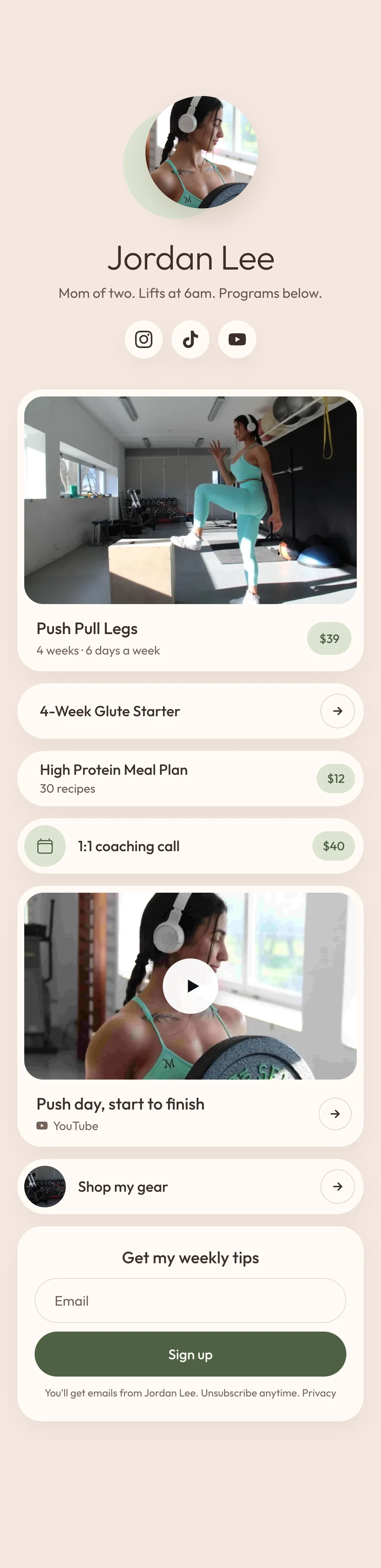
We make trainlike.link, so take this part as the pitch. It’s a store for fitness creators that goes in your bio. You build your program in it from an exercise library where every exercise has a video, set a price, and sell it next to your files, paid calls and links. It’s free to start and takes 9% when you make a sale, which is the cut used in the table above. Or it’s $29 a month and takes nothing.
Questions people ask
How much should I charge for a 12-week workout program?
About the same as a shorter one, so somewhere between $25 and $50. In the stores we looked at, a 12-week program cost $26.99 and a 4-week one cost $111. What's in the program moved the price far more than the number of weeks did.
Should I charge more if I have more followers?
Not really. Some of the biggest fitness creators sell their programs for about $40. More followers means more people see the program, so you sell more copies, but it doesn't make each copy worth more to the person buying it.
Is $10 too cheap for a workout program?
We think so. After a 9% store cut and the card fee you keep about $8.50, and you'd need around 118 sales to make $1,000. At $29 you'd need 40.
Should my first program be free?
Give away a week of it, and charge for the whole thing. A free week lets people try how you train, and you can ask for an email address in return. If the whole program is free, you still don't know whether anyone would pay for it.
Can I raise the price later?
Yes, and most creators do. People who bought at the old price already have the program, so they have nothing to complain about. A good time to raise it is when you have a few reviews to put on the page.
Should I charge once or every month?
Charge once for a program. A monthly price only works if you add something new every month, like fresh workouts, and you're sure you'll keep doing it.
How much should I charge for a custom workout plan?
More than for a program, because you write it for one person and it takes your time. Work out how many hours a month that person will take, decide what an hour of your time is worth, and multiply. Monthly coaching in the stores we looked at cost $79 and $149.
Where the numbers came from
Read in November 2026.
- The eight programs in the table are from the creators’ own store pages. We’ve left their names out.
- The bigger creators’ prices are from their own shops and apps.
- Stripe’s pricing, for the card fee.
- Chicago Booth Review on prices ending in 99, about the working paper “More than a Penny’s Worth: Left-Digit Bias and Firm Pricing” by Avner Strulov-Shlain.
- Shiv, Carmon and Ariely, “Placebo Effects of Marketing Actions: Consumers May Get What They Pay For”, Journal of Marketing Research, 2005, for the energy drink study.
- The “$50 to $500” and “$100 to $1,000” ranges are from a gym software company’s blog, which gives no source for them.